2 clarinets
✉️ If you wish to perform the piece, please contact me
Duration: ≈ 9′
Year: 2018
This work is the result of a whim, of a need to continue my research after the residency cycle at Casa da Música had ended. Nowadays, composers are relatively free to compose whatever they want, but sometimes the instrumentation is a constraint that clashes with their wishes. In this case, as it was not the result of a commission, I had a choice. So I composed for two clarinets. Some of the reasons for this are hidden in an inexplicable need, but others are clear and objective: it is my instrument and I could play and feel what I was writing; I wanted to explore the clarinet in a different way from what I had done in my last piece for solo clarinet; I wanted to create a piece that was mechanically organic and develop an idiom from there.
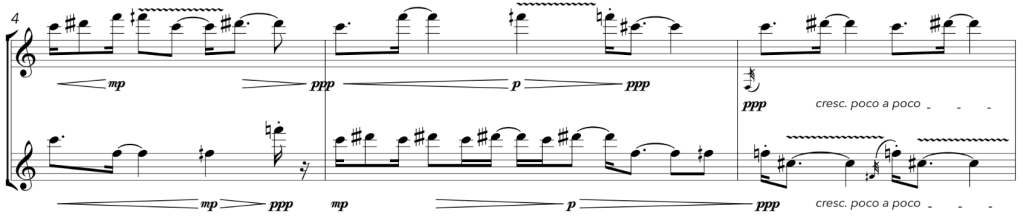
This impulse was looking for order. After writing the works for Casa da Música, in which at certain moments there is an abandonment to the whims of the imagination, I felt that I should create a system with greater restrictions. I invented a simple 5-note material (plus one added in the middle of the piece). It is not a scale like the one we learn at the conservatory, but a series of notes in which each one can only be followed by other predetermined ones. This created a rigorous sequential logic, prohibiting, for example, a C from going to C# and only being able to go to D 3⁄4 and F.
The microtonality present in this work represents my desire to create an idiom that can be performed by any musician who has graduated from the conservatory and is willing to learn, avoiding the magnanimous mission of tackling a work full of quarter tones. I do not want to neglect the expressive potential of those who are unfamiliar with contemporary music, but rather to enter into an open dialogue.
The five notes used may remind us of the idea of pentatonic. This is not fortuitous. The notes were chosen because they sounded good to me, and it is in this pleasant aspect that I aspired to record bold gestures.
Another aspect that emerged was the exploration of bisbigliandi – some are more microtonal trills than mere changes in color, but here the classification is, for me, irrelevant. The determination of each bisbigliando position makes the work unique for this instrument. I find this approach more interesting, without the possibility of transcription or adaptation.
As for the rhythm, it is expressed in transformations and permutations of a series of five proportions. Rhythmic loops of duration x versus loops of notes with duration y is one of the new techniques I use. The rest are a continuation of the technique already used in my work for ensemble “febres de arabescos em frisos inertes” (fevers of arabesques in inert friezes), although its application is in a more conventional notation and with a restrained use of tuplets.
 Luís Neto da Costa