Flute (+piccolo +alto flute), oboe, clarinet, bassoon, horn, trumpet, trombone, 2 percussionists, harp, piano (+keyboard), guitar, 2 violins, viola, cello, double bass
✉️ If you wish to perform the piece, please contact me
Duration: ≈ 11′
Year: 2017
Commissioned by Casa da Música (Young Composer in Residence 2017)
Premiered by Remix Ensemble by Peter Rundel
I could have neglected the theme of this concert, but I found the idea of creating a work based on the influence of Baroque music on contemporary music appealing. Avoiding the use of quotations, allusions, or sound material taken directly from works by Baroque composers, I preferred to abstractly remodel some general concepts attributed to that period and take them as the starting point for my material and the sections of the work. Some of these concepts, such as passus duriusculus, choral harmonization, fugue stretto, and ornamentation, served as inspiration to alter their meanings in order to create new contexts.
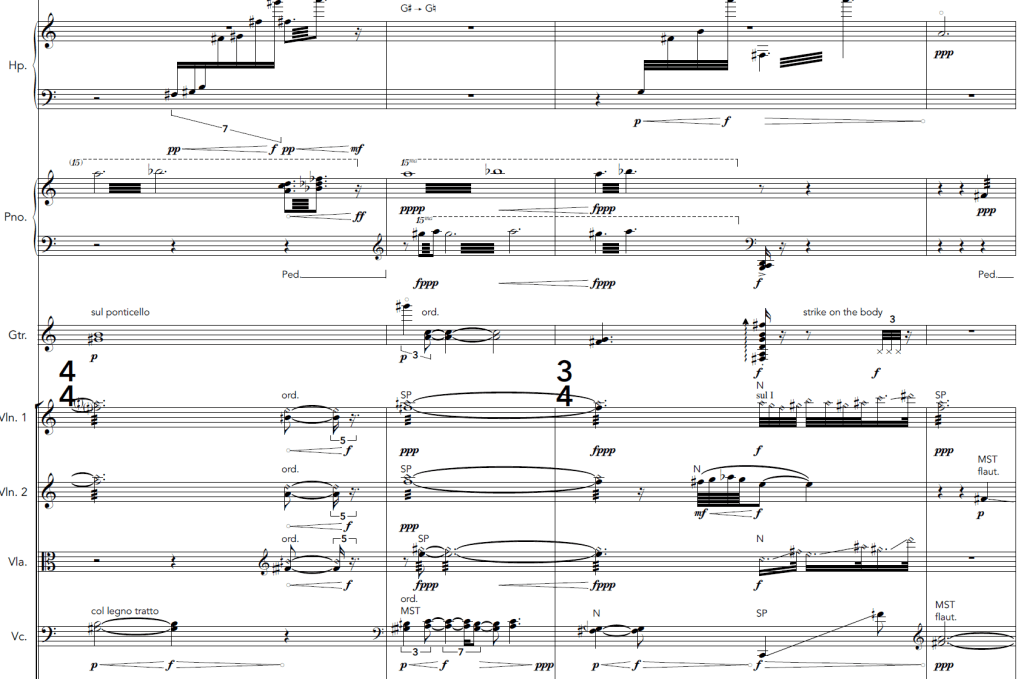
One such example is the distortion of the definition of counterpoint—the independence of voices—which is taken to the extreme, resulting in a layer of voices that follow different speeds and directions but meet at points of convergence.
The concept of the tonal scale is also transformed. Its seven notes have different hierarchies, different weights, and the conduction of notes is not as free as one might think. Each note has certain poles of attraction and patterns of movement. In order to reflect this definition, a system was created in which a note can only be followed by a specific group of notes. This principle, based on LSystems, gives the impression of a tree branch that gradually branches out, creating a unique path. With all these constraints, I believe that an intuitive sound memory will be created.
As for the rhythm, it is based on a motif of five rhythmic proportions. Throughout the work, this set is expanded, shortened, and permuted. It is the parameter that stands out the most, since its fluidity and continuity are not the discrete proportions so common in music. The irrationality and apparent desynchronization are like scratches or brushstrokes that do not seek a smooth and polished design.
And now the title. In the difficulty of finding one that would not corrupt free listening, fevers of arabesques in inert friezes was a happy discovery in Fernando Pessoa’s Book of Disquiet. The reference to the term “arabesques” was one of the main requirements, as it was an allusion to the baroque ornamentation used in the work and a reference to the extreme contrapuntal independence that certain lines achieve. With its great imaginative capacity, the title gave me the impression that it described the sound concept I have of the work.
 Luís Neto da Costa